
Short answer: a stock-configuration Chevrolet C10 (1960–1987) books at roughly $9,000 to $20,000 in good (#3) condition, while a professionally built LS- or LT-powered restomod is currently listed at RK Motors from $96,900 to $144,900, and a show-level build reaches $335,900. That puts a pro-built restomod at roughly five to seven times a good stock truck of the same year. The 1967–72 “Action Line” trucks are the core of the market, making up 64 of the 90 C10s RK Motors has sold (71%), and three out of four of everything we’ve sold was a custom build rather than a truck restored to stock.
This is the next chapter in our RK Knows series. Like our guides to the C3 Corvette and the Mustang Mach 1 and Boss, it puts an entire run of one model into a single reference, here three generations of Chevy half-ton, backed by RK Motors’ own sold history and current public market benchmarks. Many of the buyers who shop C10s also shop vintage Broncos, so read it alongside The Restomod Bronco Boom, and see The Builder Signature Premium for how builder reputation moves prices.
What RK Motors’ Own Sales Data Shows
RK Motors’ public sold archive currently lists 90 sold Chevrolet C10 pickups. Broken down by model year:
| Model year | C10s sold by RK Motors | Share of total |
|---|---|---|
| 1961 | 1 | 1% |
| 1963 | 2 | 2% |
| 1964 | 3 | 3% |
| 1965 | 7 | 8% |
| 1966 | 5 | 6% |
| 1960–1966 subtotal | 18 | 20% |
| 1967 | 7 | 8% |
| 1968 | 11 | 12% |
| 1969 | 7 | 8% |
| 1970 | 14 | 16% |
| 1971 | 8 | 9% |
| 1972 | 17 | 19% |
| 1967–1972 “Action Line” subtotal | 64 | 71% |
| 1973–1979 | 0 | 0% |
| 1980 | 1 | 1% |
| 1983 | 1 | 1% |
| 1985 | 3 | 3% |
| 1987 | 3 | 3% |
| 1973–1987 “Square Body” subtotal | 8 | 9% |
| Total | 90 | 100% |
And by generation and drivetrain, based on how each truck was headlined:
| Generation | Sold | LS/LT-powered | Other custom or restomod | Restored, stock-style |
|---|---|---|---|---|
| 1960–1966 | 18 | 8 (44%) | 6 | 4 |
| 1967–1972 | 64 | 24 (38%) | 24 | 16 |
| 1973–1987 | 8 | 2 (25%) | 3 | 3 |
| Total | 90 | 34 (38%) | 33 | 23 |
Here’s what that data tells us:
- The 1967–72 trucks are the heart of the market. They account for 64 of our 90 C10 sales (71%). 1972 alone is 17 sales and 1970 is 14, and 1968 adds another 11.
- Three out of four are custom builds. Of our 90 sold C10s, 67 (74%) were headlined as restomods, custom builds, or LS/LT-powered trucks, and only 23 (26%) as restored-to-stock-style trucks. The C10 is one of the few collector models where the customized truck is the mainstream product.
- The LS swap is the most common recipe, and it is accelerating. 34 of our 90 sold trucks (38%) are LS- or LT-powered. Among our 20 most recent C10 sales, 13 (65%) were LS/LT builds, compared with 21 of the 70 before that (30%).
- But “restomod” doesn’t always mean LS. Another 33 custom builds run traditional Chevy power: 350 and 383 small-blocks, 454 big-blocks, a 502 Ramjet, a ZZ427, even a 489 stroker. In all, 15 of our sold C10 headlines cite a big-block engine.
- Modern comfort is the baseline. 76 of 90 headlines (84%) advertise air conditioning and 74 (82%) an automatic transmission, and 8 cite air-ride suspension. Six trucks were supercharged.
- Square Bodies are the thinnest part of our data. Only 8 of 90 sales (9%) are 1973–87 trucks, and just two of those are LS/LT swaps (a 1985 Silverado and a 1987 truck with a 6.2L and an 8-speed automatic).
Methodology note: counts come from RK Motors’ public sold-inventory listings for Chevrolet C10 pickups as of October 2026 (a search for “C10” returns 94 sold vehicles; four non-C10 results, a 1953 Ford, two 2012 Lexus LFAs and a 2012 Can-Am Spyder, are excluded). “LS/LT-powered,” “other custom or restomod,” and “restored, stock-style” classifications are based on each listing’s published headline; one 1965 truck with no engine in its headline is counted as restored, stock-style. “Most recent” is based on listing order in the archive. Percentages are rounded.
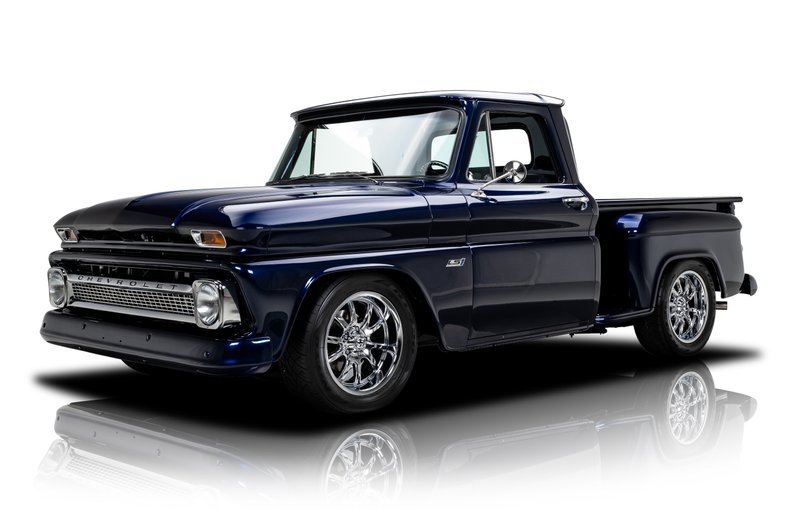
The Three C10 Generations: A Buyer’s Guide
Chevrolet’s half-ton C10 wore three distinct bodies between 1960 and 1987. Each has its own price tier, its own typical restomod recipe, and its own things to check before you buy. To anchor the numbers, here are Hagerty’s October 2026 Price Guide values for good (#3) condition, base-spec short-bed Fleetside trucks. Hagerty’s base configuration is a six-cylinder 2WD truck, so V8 and optioned trucks trade above these figures:
| Truck | Hagerty #3 (Good) value | Annual change | Three-year change |
|---|---|---|---|
| 1964–1965 C10 | $19,800 | 0% | −10.4% |
| 1967 C10 | $13,300 | +0.8% | +1.5% |
| 1971–1972 C10 | $15,200 | +1.3% | +1.3% |
| 1985 C10 | $9,100 | −6.2% | +4.6% |
Real-world trades look different from base-spec guide values because the trucks that actually sell are restored or built. Hagerty’s trailing 12-month data shows 448 sales of 1967–72 C/K pickups totaling $24.8 million, up 23% in vehicles sold, at an average of $55,300. For 1973–91 C/K pickups it shows 350 sales totaling $11.9 million, which works out to roughly $34,000 per truck by our arithmetic.
1960–1966: The Early Trucks
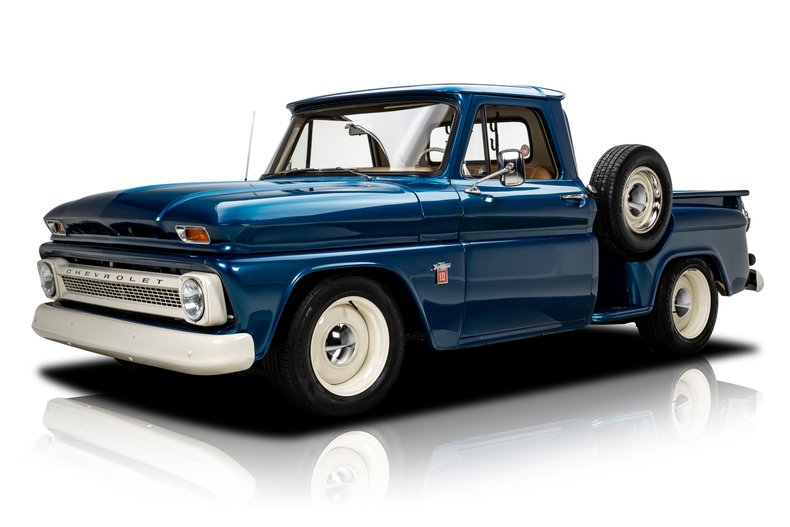
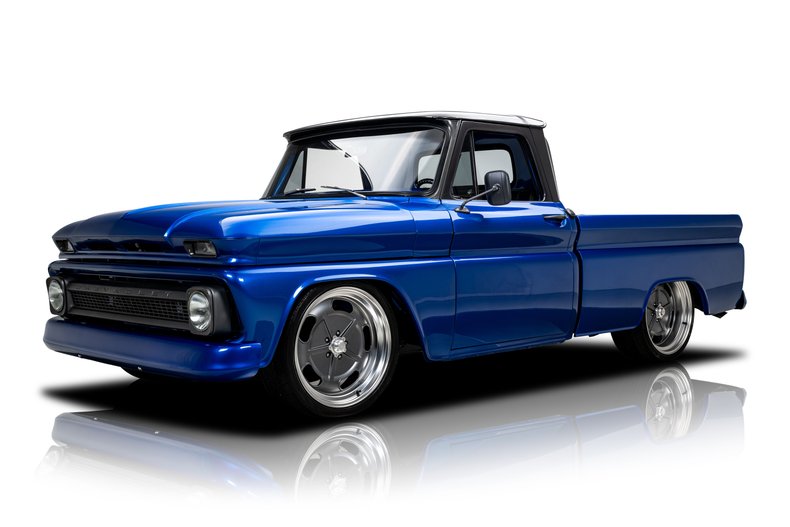
The first-generation C10 arrived for 1960 with a dramatic restyle, aircraft-inspired hood sculpting, and independent front suspension, and it remains the most stylized of the three bodies. RK Motors has sold 18 of them (20% of our C10 volume), led by 1965 with seven and 1966 with five. This generation has the highest LS/LT share of the three at 44% (8 of 18), and the short, simple, upright shape of a Stepside or Fleetside from this era is a favorite canvas for builders.
The stock benchmark is the highest of the three, at $19,800 for a 1964–65 truck in #3 condition, though Hagerty shows it down 10.4% over three years, the only one of the four benchmarks showing a three-year decline. Our current 1964 C10 with a Gen V 5.3L LT V8, 6-speed automatic, A/C and RideTech suspension is listed at $99,900, and a 1965 big-window LS truck with air ride is $144,900. In our sold archive you’ll find a professionally built 1966 with an LS1, a 1966 LS2 truck with a Tremec T56 6-speed, a 1963 Stepside restomod, and a restored 1964 with a 350. Bed wood, cab corners, floors, and inner fenders deserve a close look on any early truck.
1967–1972: The “Action Line” Trucks
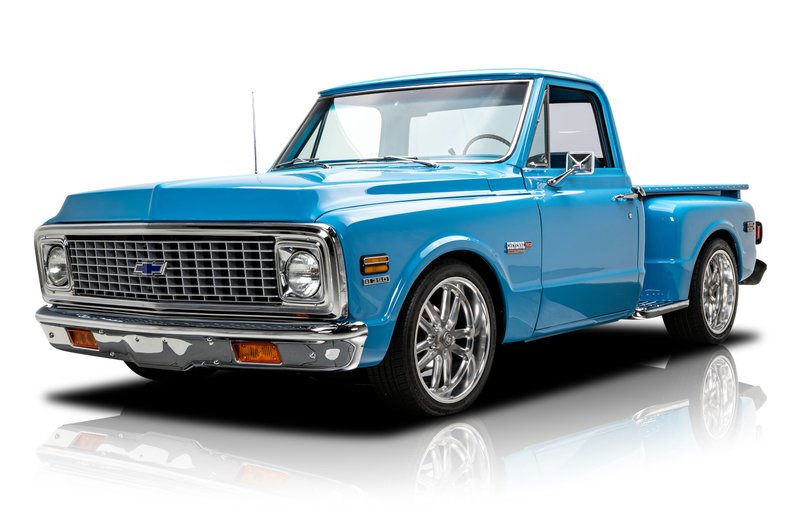
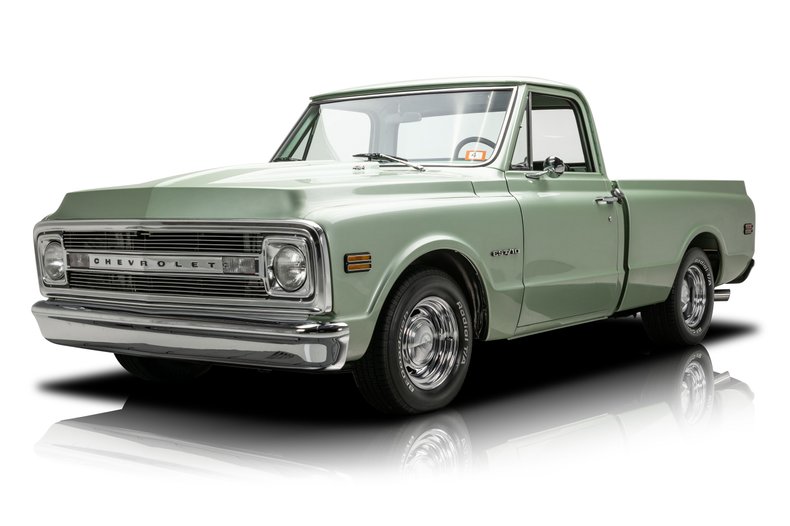
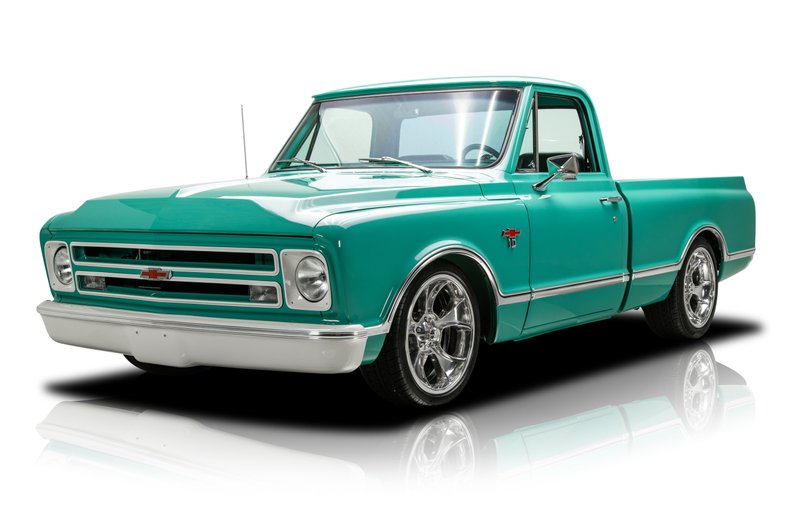
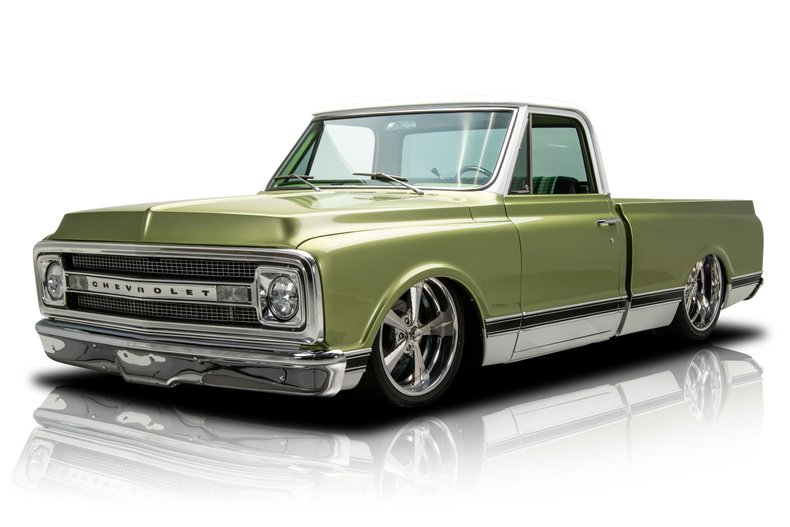
This is the generation most people picture when they say “classic Chevy truck,” and it is the center of RK Motors’ C10 business: 64 sold trucks, 71% of the total. It is the only generation where all three recipes are well represented, with 24 LS/LT builds, 24 other custom builds, and 16 restored trucks.
Details matter within the run. The 1967 trucks have a small rear window and no side marker lights, 1968 added markers and a larger back window, 1969 was the first year for the 350 small-block option, and 1970 brought the Mark IV big-block (a 402, badged as a 400). Front disc brakes became standard for 1971, the year the Cheyenne trim arrived, and the 1971–72 trucks share the egg-crate grille that tends to make them the most popular years. Per Hagerty, wood bed floors bring a premium over steel. Our sold archive shows the whole spread: a restored 1972 Cheyenne Super Stepside with a 350, a 1970 short bed with a 454 and a 4-speed, a 1971 with an LS3 on an NLE chassis, and a 1972 with a supercharged LS9 on air ride.
Pricing here has the widest spread. Hagerty values base-spec trucks at $13,300 (1967) to $15,200 (1971–72) in #3 condition, yet its 12-month average sale across the generation is $55,300, and its highest 1967 sale in the past three years was $330,000. CLASSIC.COM’s current second-generation C10 listings show asking prices from $14,900 to $119,650, averaging about $49,300 across the 23 priced listings we reviewed.
1973–1987: The Square Body
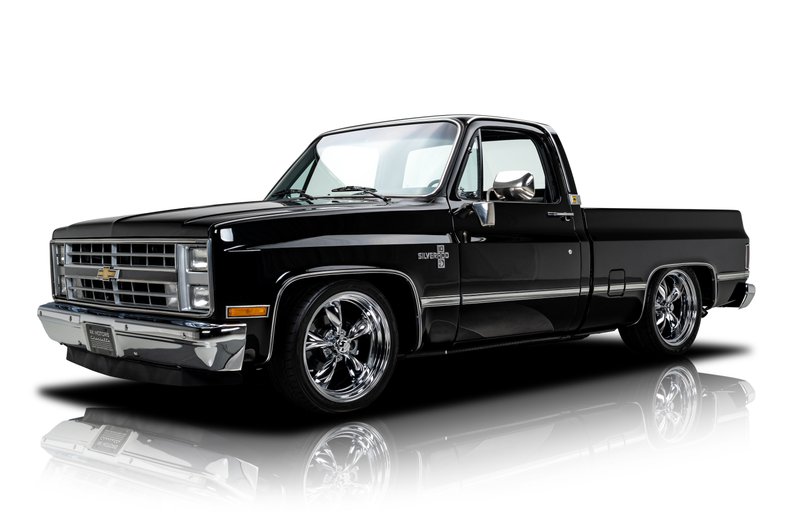
The Square Body is the entry point, and also the youngest part of the collector market. RK Motors has sold 8 (9%), with three each from 1985 and 1987. Hagerty’s 1985 base-spec truck is $9,100 in #3 condition, down 6.2% over the past year, while CLASSIC.COM’s five-year Square Body average is about $26,000 as reported by SlashGear. Top-end sales show what a top build can do: a 1983 C10 custom brought $228,250 at Mecum in January 2023.
RK Motors’ Square Body sales run the range: a frame-off restored 1985 Silverado with a 355, an LS-swapped 1985 Silverado with a 5.3L, a 1987 truck with a 6.2L LT and an 8-speed automatic, a 383-powered 1987 shortbed, and a 15,260-mile 1987 Silverado. The best-bought Square Bodies tend to be either low-mile survivors or well-executed swaps, because a weak build is hard to recover its cost on at these entry prices.
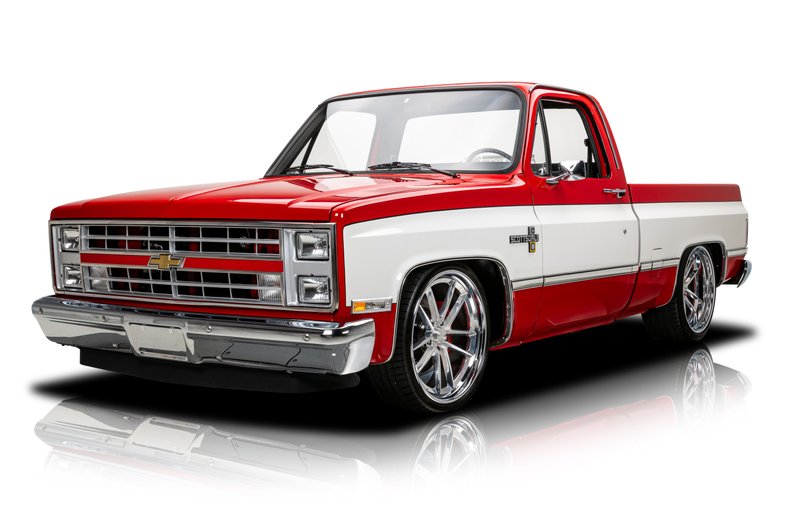
Stock vs. LS-Swapped: The Price Gap
RK Motors’ archive doesn’t publish sale prices, so we measured the gap from the live side: what our current C10 builds are listed for, against Hagerty’s October 2026 stock benchmark for the same model year.
| RK Motors C10 (currently for sale) | Asking price | Hagerty stock (#3) | Gap | Multiple |
|---|---|---|---|---|
| 1964, Gen V 5.3L LT, 6-speed automatic | $99,900 | $19,800 | +$80,100 | 5.0x |
| 1965, big-window LS, air ride | $144,900 | $19,800 | +$125,100 | 7.3x |
| 1971, ZZ4 350 EFI, custom | $96,900 | $15,200 | +$81,700 | 6.4x |
| 1967, Scott’s Hot Rods, 525hp LS3 | $335,900 | $13,300 | +$322,600 | 25.3x |
The three pro-built trucks average $113,900, about 6.2 times the roughly $18,300 average of their three stock benchmarks. The Scott’s Hot Rods truck is in a category of its own: a named-builder, fabricated-chassis build that was also the most-viewed truck in the data behind our Bronco analysis.
Two caveats keep that multiple honest. First, Hagerty’s #3 figure is a base-spec six-cylinder truck, and a correctly restored V8 truck trades well above it. Second, the market’s real average is higher: against Hagerty’s $55,300 average sale for 1967–72 C/K trucks, our three pro-built builds are about 1.8x to 2.6x. So the right way to read the gap is that a pro-built LS restomod costs roughly two times what a finished, restored truck sells for, and five to seven times what a tired, base-spec truck is worth on paper. For comparison, our Bronco analysis found restomods selling for three to five times the roughly $37,000–$75,000 range of stock 1974 Broncos, so the C10’s multiple at the pro-built tier is wider, in part because the stock starting point is lower.
What the premium buys is mostly invisible in a photo: a modern drivetrain, upgraded chassis and brakes, air conditioning, a real interior, and the hours of fabrication that make all of it fit. As we covered in The Builder Signature Premium and Why Pro Touring Isn’t a Trend Anymore, builder reputation and build quality drive restomod pricing far more than the engine code does.
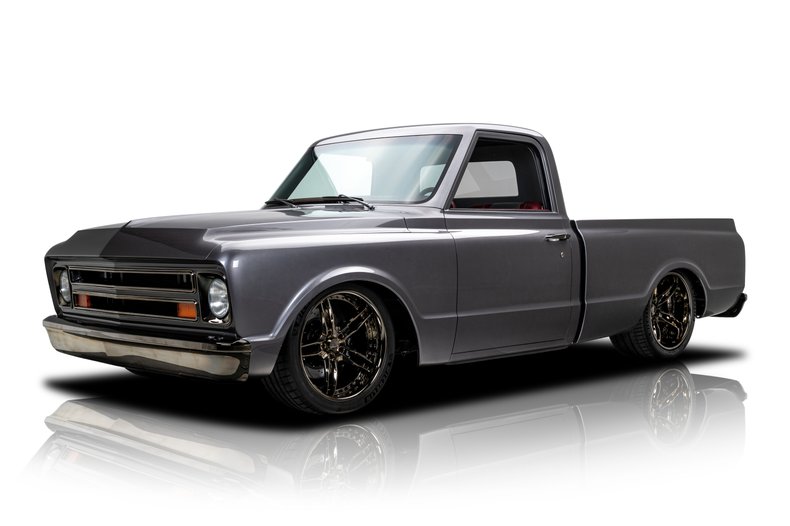
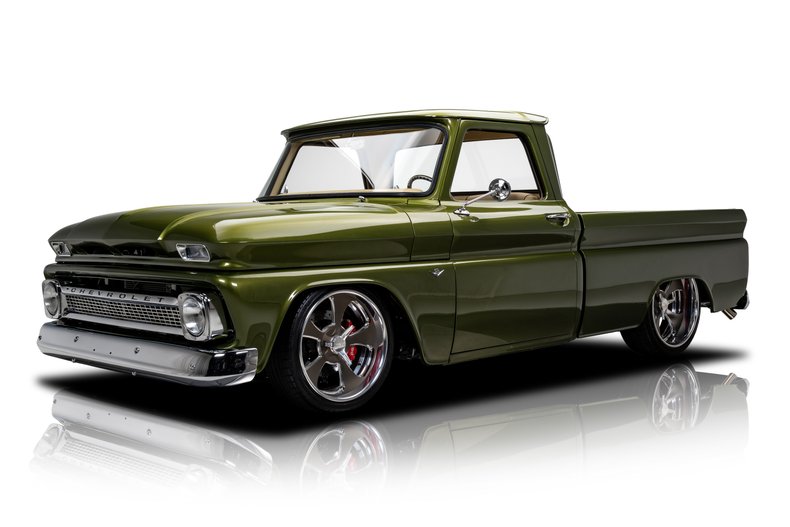
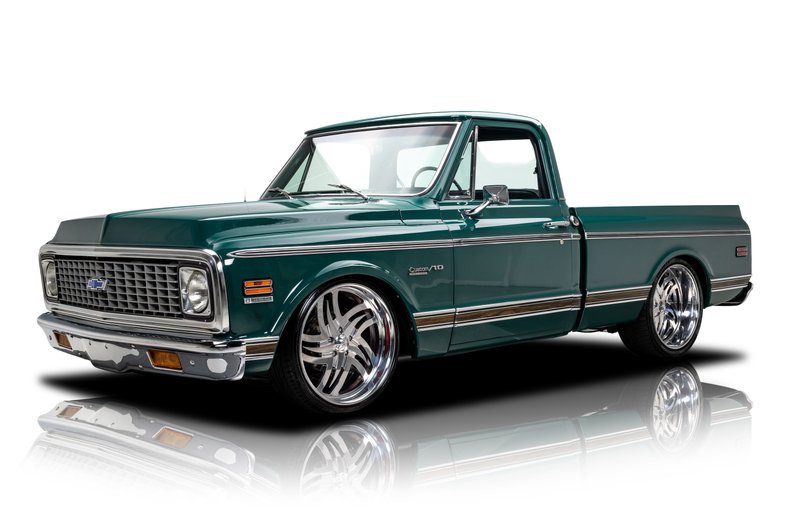
The C10 Price Ladder: What Each Tier Is Worth Right Now
Like the Corvette, the C10 market is best understood as a ladder. Benchmarks below are Hagerty Price Guide and sales data from October 2026, CLASSIC.COM data, and RK Motors’ own current asking prices. Rungs 1 through 3 are base-spec guide values; V8 and optioned trucks trade above them.
| Rung | What it is | Current market benchmark |
|---|---|---|
| 1. Square Body drivers | 1973–87 trucks in stock configuration | ~$9,100 (Hagerty 1985 #3); ~$26,000 five-year average across conditions (CLASSIC.COM via SlashGear) |
| 2. Stock 1967–72 drivers | Base-spec 2WD trucks in good condition | ~$13,300 (1967) to ~$15,200 (1971–72), Hagerty #3 |
| 3. Stock 1960–66 drivers | Base-spec early trucks in good condition | ~$19,800 (1964–65), Hagerty #3 |
| 4. Restored and modified trucks that actually trade | The mix of restored and built trucks sold at auction | ~$55,300 average (1967–72) and ~$34,000 average (1973–91), trailing 12 months |
| 5. Pro-built LS/LT restomods | Modern drivetrain, upgraded chassis, brakes and A/C | RK Motors current listings: $96,900 to $144,900 |
| 6. Show-level named-builder builds | Fabricated chassis, top-tier finish | RK Motors current listing: $335,900; Hagerty highest 1967 sale in three years: $330,000; Square Body five-year top sale: $228,250 |
Which C10 Years Hold Value Best
These are observations from the data, not investment advice.
- 1967–1972: the deepest market and the most stable benchmarks. Hagerty shows base-spec values up 0.8% to 1.3% over the past year, vehicles sold up 23%, and these years are 71% of RK Motors’ C10 sales.
- 1960–1966: the highest stock benchmark ($19,800) and the highest LS/LT share of our sales (44%), but also the one benchmark that has slipped over three years (−10.4%). Build quality matters more than the badge here.
- 1973–1987: the lowest entry price and the softest recent trend (the 1985 benchmark is down 6.2% over a year). Value holds best in low-mile survivors and well-built swaps.
What Moves a C10 Up or Down the Ladder
- Build quality and builder: chassis, suspension, brakes and fit and finish matter more than the engine code on a restomod.
- Drivetrain: LS/LT and Gen V builds dominate our recent sales (13 of the last 20), but a well-executed big-block or small-block build still has a following.
- Body style and trim: Fleetside versus Stepside, short versus long bed, and trims like CST, Cheyenne and Cheyenne Super all move prices, and Hagerty notes wood bed floors bring a premium over steel.
- Originality versus modification: a documented, restored-to-stock truck and a pro-built restomod are two different markets, and neither is a bargain version of the other.
- Comfort and drivability: A/C, power disc brakes, power steering and a modern automatic appear in the large majority of our sold trucks.
- Documentation: build receipts, restoration photos and ownership history are what separate a pro-built truck from an unfinished project.
- Platform condition: rust repair, frame condition and bed wood are the hidden costs behind many “bargain” trucks.
Frequently Asked Questions
What is a Chevy C10 worth right now?
It depends almost entirely on what kind of truck it is. Hagerty’s October 2026 base-spec benchmarks for a good (#3) truck run from about $9,100 for a 1985 to $19,800 for a 1964–65. Hagerty’s average sale across 1967–72 C/K pickups is $55,300 because the trucks that sell are mostly restored or built, and RK Motors’ current pro-built C10s are listed from $96,900 to $144,900, with a show-level build at $335,900.
How much more is an LS-swapped C10 worth than a stock one?
Against a base-spec stock truck, RK Motors’ current pro-built LS/LT trucks are listed at about five to seven times Hagerty’s #3 value for the same year. Against the average sale price of restored and modified 1967–72 trucks ($55,300), the multiple is closer to two. The build quality and the builder matter more than the engine.
Why are C10s so popular for restomods?
Several reasons stack up. The trucks were built in large numbers, so there are plenty of platforms and parts, and the design is simple and clean enough that a modern drivetrain, disc brakes, air conditioning and coilover suspension transform it without changing its character. Hagerty describes this era of Chevy trucks as good-looking, well built and easy to drive in modern traffic, with engines shared with popular Chevy cars that make restoration and upgrades relatively easy. The entry price is also low (Hagerty’s base-spec trucks run $9,100 to $19,800), and the aftermarket for chassis, suspension and swap kits is deep. The result shows up in our data: 74% of the C10s we’ve sold were custom builds, 38% were LS- or LT-powered, and 84% of headlines advertise air conditioning.
What are the differences between the three C10 generations?
The 1960–66 trucks have the most dramatic early styling and the highest stock benchmark. The 1967–72 “Action Line” trucks are the center of the market and 71% of RK Motors’ C10 sales. The 1973–87 Square Body is the lowest-priced and youngest of the three. See the buyer’s guide above for details on each.
Are Square Body C10s worth buying?
For the right buyer, yes. They are the most affordable of the three generations (Hagerty’s 1985 benchmark is $9,100, and CLASSIC.COM’s five-year Square Body average is about $26,000), and builders are increasingly using modern LT drivetrains and 8-speed automatics in them, as in our sold 1987 truck. Look for low-mile survivors or well-built swaps, and keep in mind Hagerty’s benchmark for the 1985 is down 6.2% over the past year.
Should I restore a C10 to stock or build a restomod?
The market gives both a place, but they are different products. Restored trucks (26% of our sold C10s) appeal to buyers who value originality and documentation, while restomods (74%) appeal to buyers who want to drive the truck. If you plan to drive it on modern roads, a well-built restomod is usually the more usable choice, and our data suggests that’s what most buyers choose.
Is a C10 a good investment?
We’re not able to offer investment advice. What we can share is observable demand: Hagerty reports 448 sales of 1967–72 C/K pickups over the past 12 months, up 23% in vehicles sold, while base-spec benchmarks have moved between −6.2% and +1.3% over the past year. Anyone buying with investment in mind should treat a C10 as a discretionary purchase first and consult an independent financial advisor.
Can I finance a C10 at RK Motors?
Yes. RK Motors works with financing partners who specialize in collector vehicles, and you can review them on our finance page. One of them, Woodside Credit, advertises payment plans up to 12 years for purchases from $10,000 to $600,000, a range that covers every truck currently in our inventory. Terms, rates and approval are set by the lender, so apply to see what you qualify for.
I’m also shopping Broncos. How do the two compare?
Many of the same buyers cross-shop vintage trucks and SUVs, and the two markets share a playbook: a simple, recognizable body, a modern drivetrain, and a premium for build quality. Our Bronco analysis found restomods selling for three to five times the price of stock 1974 Broncos, while the C10 gap at the pro-built tier is wider because the stock starting point is lower. Read The Restomod Bronco Boom for the full comparison.
How many C10s has RK Motors sold?
RK Motors’ public sold inventory currently lists 90 Chevrolet C10 pickups, including 17 1972s, 14 1970s and 11 1968s. Of those, 34 are LS/LT-powered and 13 of our 20 most recent sales were LS/LT builds.
Does RK Motors ship C10s?
Yes. Every RK Motors listing can be shipped anywhere in the world, and each vehicle receives a comprehensive, multi-point inspection before it’s listed for sale.
Where can I see RK Motors’ current and sold C10s?
Browse all current C10 inventory, or review past sales in our sold C10 archive. For the bigger picture on builds, read The Builder Signature Premium. If you own a C10 and are thinking about selling, learn about consigning with RK Motors.
Market benchmarks: Hagerty Price Guide values for 1964, 1965, 1967, 1971–72 and 1985 Chevrolet C10 half-ton trucks (October 2026); Hagerty trailing 12-month sales data for 1967–72 and 1973–91 Chevrolet C/K pickups; CLASSIC.COM second-generation C10 marketplace listings (October 2026); CLASSIC.COM Square Body sales data as reported by SlashGear. RK Motors data: public sold and current inventory listings, October 2026.