
Short answer: right now, a C2 Corvette (1963–1967) is worth anywhere from the high five figures for a driver-quality small-block car to well over $150,000 for a documented 427/435 or fuel-injected example, with 1963 split-window coupes and professionally built restomods regularly trading between roughly $150,000 and $400,000. The single biggest variable isn’t the year. It’s the engine code, and whether the car can prove it still has the one it left St. Louis with.
This guide pulls together two things RK Motors has written about before, The Corvette Ladder and the $70,000 bare split-window shell, and puts them into one reference for the entire mid-year generation, backed by our own sold history and current public market benchmarks.
What RK Motors’ Own Sales Data Shows
RK Motors’ sold archive, which is public on our website, currently lists 217 sold 1963–1967 Corvettes. Broken down by model year:
| Model year | C2 Corvettes sold by RK Motors | Share of total |
|---|---|---|
| 1963 | 47 (31 of them split-window coupes) | 22% |
| 1964 | 24 | 11% |
| 1965 | 28 | 13% |
| 1966 | 50 | 23% |
| 1967 | 68 | 31% |
| Total | 217 | 100% |
A few patterns stand out:
- The bookend years dominate. 1966 and 1967 together account for 118 cars, or 54% of every C2 we’ve sold. Those are the big-block years, and 1967 is the final, most-refined version of the body.
- The split-window is a category of its own. 31 of our 47 sold 1963s were split-window coupes. Roughly half (15) were factory-style restorations or survivors; the other 16 were restomods or custom builds.
- Big-blocks drive the factory-correct side. Of roughly 135 factory-style (non-restomod) C2s we’ve sold, about 56, or 41%, were big-block cars (396 or 427). About 25 of those were Tri-Power 427s, and 15 more factory-style cars were fuel-injected “fuelies.”
- Restomods are a steady ~37% of C2 volume. About 80 of our 217 sold C2s were restomods or custom builds. That share has held steady: in our 50 most recent C2 sales it was 36%, and in our 25 most recent it was 44%. Restomods haven’t replaced factory-correct mid-years at RK Motors. They’ve become a permanent second market alongside them.
- Documentation is common at the top. 44 of our factory-style C2 listings cited NCRS, Bloomington Gold, or a combined award (Triple Crown, Triple Diamond, Duntov) in the headline alone, and 23 led with “numbers-matching.”
Methodology note: counts come from RK Motors’ public sold-inventory listings for 1963–1967 Chevrolet Corvettes as of September 2026. “Restomod” and “big-block” classifications are based on each listing’s published drivetrain description.
The C2 Price Ladder: What Each Tier Is Worth Right Now
The mid-year market is best understood as a ladder. Each rung is defined mainly by engine option, body style, and documentation. The benchmarks below are CLASSIC.COM market values by factory engine code as of September 2026; they represent a typical good example, so driver-quality cars will trade below them and judged, documented cars above.
| Rung | What it is | Current market benchmark |
|---|---|---|
| 1. Small-block drivers | L75 327/300, L79 327/350; coupes and convertibles, 1963–1967 | ~$85,000–$91,000 (L79 ~$84,800; L75 ~$90,600) |
| 2. Hydraulic-lifter big-blocks | L36 427/390 and L72 427/425 (1966–1967) | ~$114,000–$116,000 |
| 3. Early high-performance small-blocks and the L68 | L76 327/340 (1963–1964); L68 427/400 Tri-Power (1967) | ~$145,000–$153,000 |
| 4. The headline engines | L71 427/435 Tri-Power; L84 fuel-injected 327 “fuelie” (1963–1965) | ~$168,000 (L71) to ~$191,000 (L84) |
| 5. 1963 split-window coupes | One-year-only divided rear glass | Recent sales cluster roughly $130,000–$290,000 depending on engine and documentation |
| 6. Pro-built restomods | Modern LS/LT drivetrain, aftermarket chassis | RK Motors’ current C2 restomods: $195,900–$369,900 |
| 7. Blue-chip race-derived cars | 1963 Z06; 1967 L88 | ~$637,000 (Z06) to ~$1.39 million (L88) |
Rung 1: Small-block driver-quality cars
This is the entry point and by far the deepest part of the market. The 300- and 350-horsepower 327s were built in large numbers, and at any given time they make up most of the C2s for sale. Market benchmarks sit in the mid-$80,000s to low-$90,000s, and a genuine driver-quality car with a non-original engine or older restoration will typically sit below that. For buyers who want the Sting Ray shape and the mid-year driving experience without paying for rarity, this is the rung that makes sense.
Rung 2: The 390- and 425-horsepower big-blocks
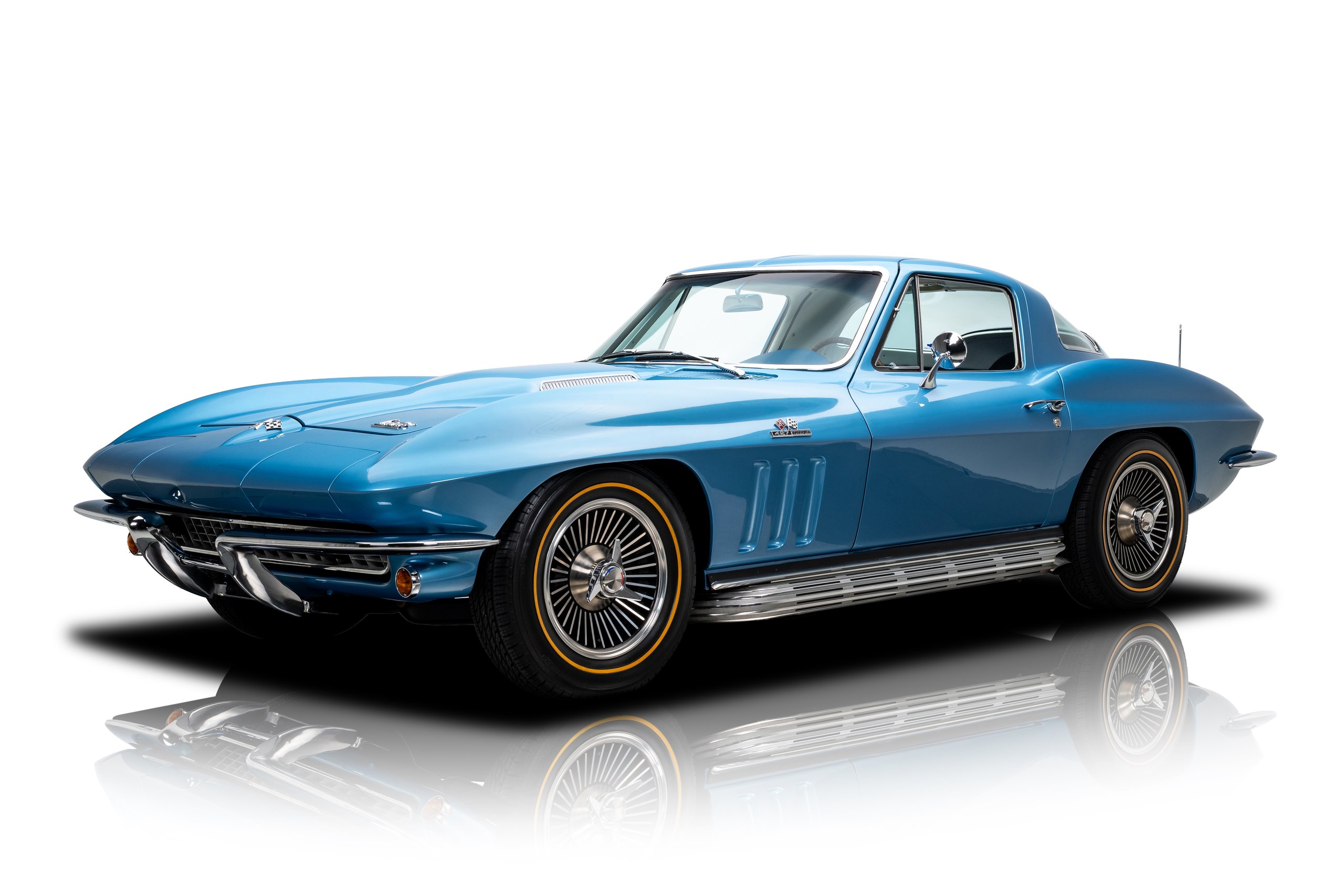
Chevrolet introduced the big-block Corvette in 1965 with the one-year-only 396/425, then moved to the 427 for 1966–1967. The L36 (390 hp) and L72 (425 hp) are the most attainable big-block C2s, currently benchmarking around $114,000–$116,000. Hagerty data cited by industry analysts puts the big-block premium at roughly 57% over a comparable small-block car in excellent condition. The stinger hood on a 1967, or the domed hood of a 1965–1966 big-block, is part of what buyers are paying for, which is also why correct big-block cars are so frequently imitated.
Example from our archive: a numbers-matching 1966 L36 coupe, since sold.
Rung 3: The L76 and L68
The solid-lifter 340-horsepower L76 was the top carbureted small-block in 1963 and 1964, and it’s the engine in the Triple Crown split-window we covered in our shell-sale story. The L68 427/400 was the 1967 Tri-Power option below the L71. Both currently benchmark in the mid-$140,000s to low-$150,000s.
Rung 4: The L71 427/435 and L84 fuelie
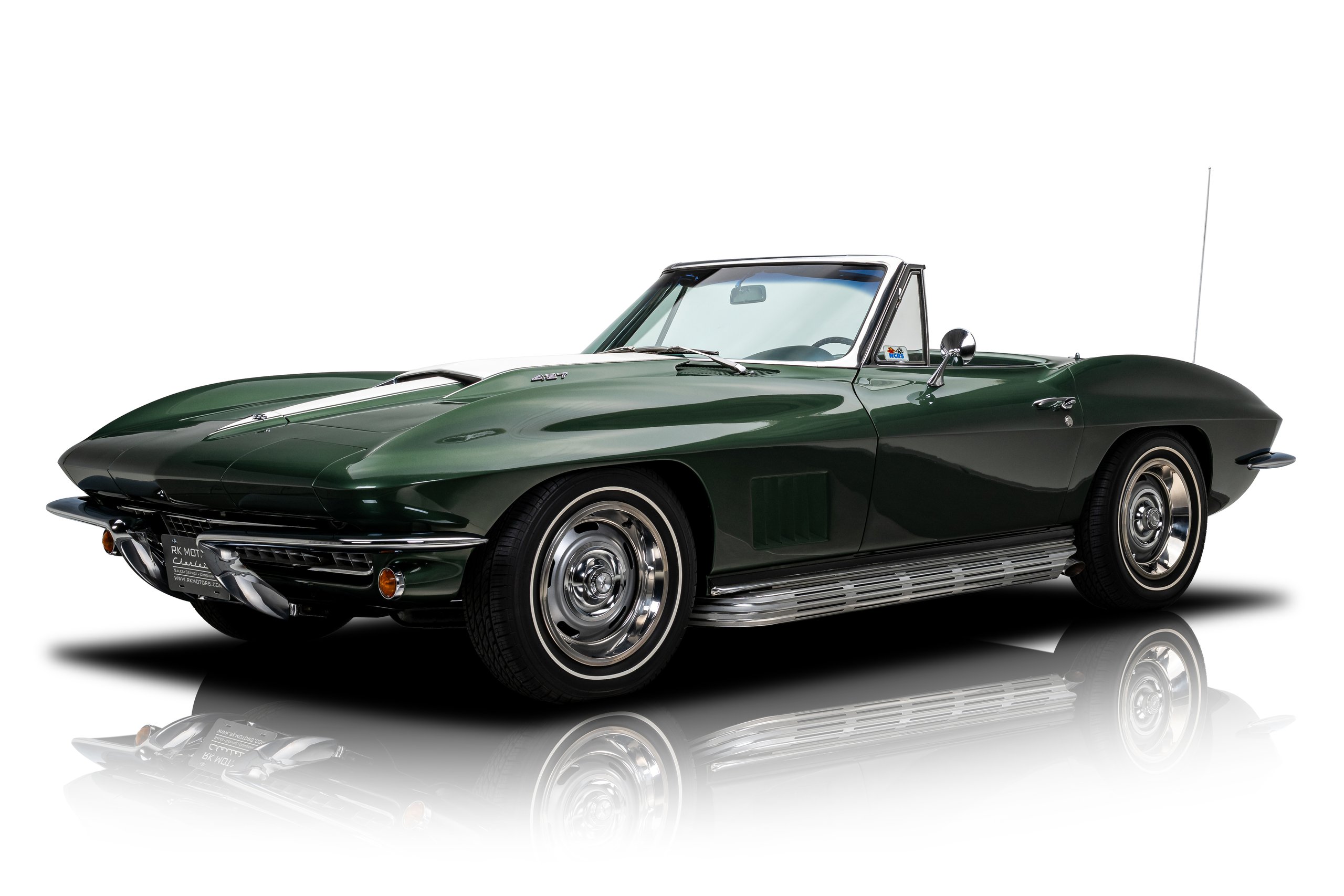
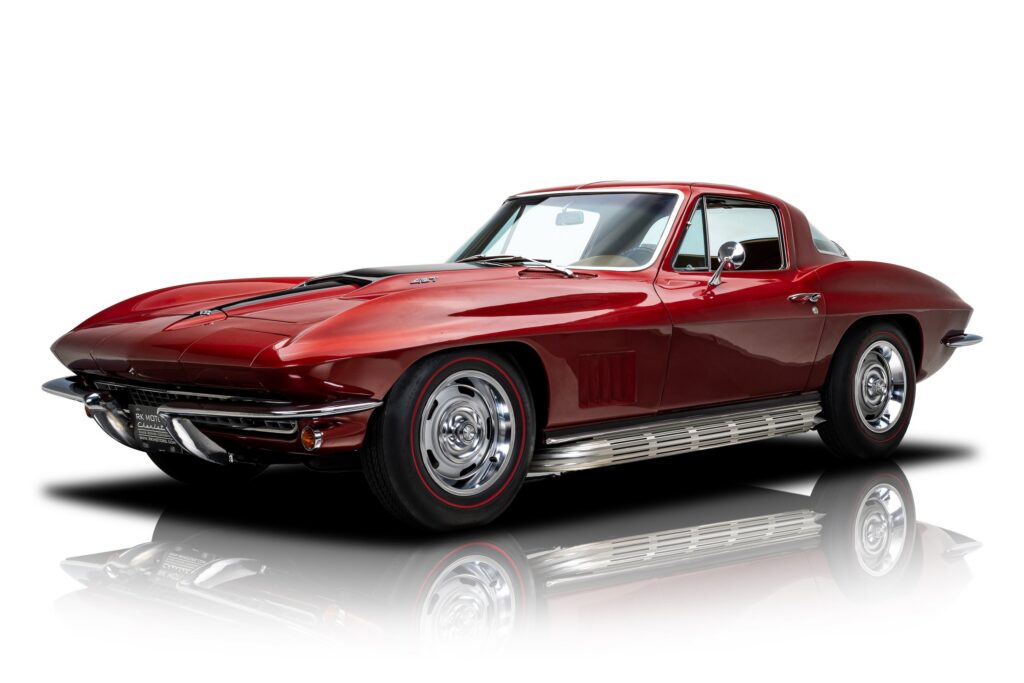
These are the engines most collectors picture when they think “valuable mid-year.” The 1967 L71, three two-barrel carburetors on a 427 rated at 435 horsepower, benchmarks near $168,000, and judged, documented examples go well beyond that. Our Triple Diamond 1967 L71 convertible, featured in The Corvette Ladder, is exactly that kind of car and has since sold. The fuel-injected L84 (360 hp in 1963, 375 hp in 1964–1965) benchmarks near $191,000, the highest of the regular-production engines below the race-derived cars.
Rung 5: The 1963 split-window coupe
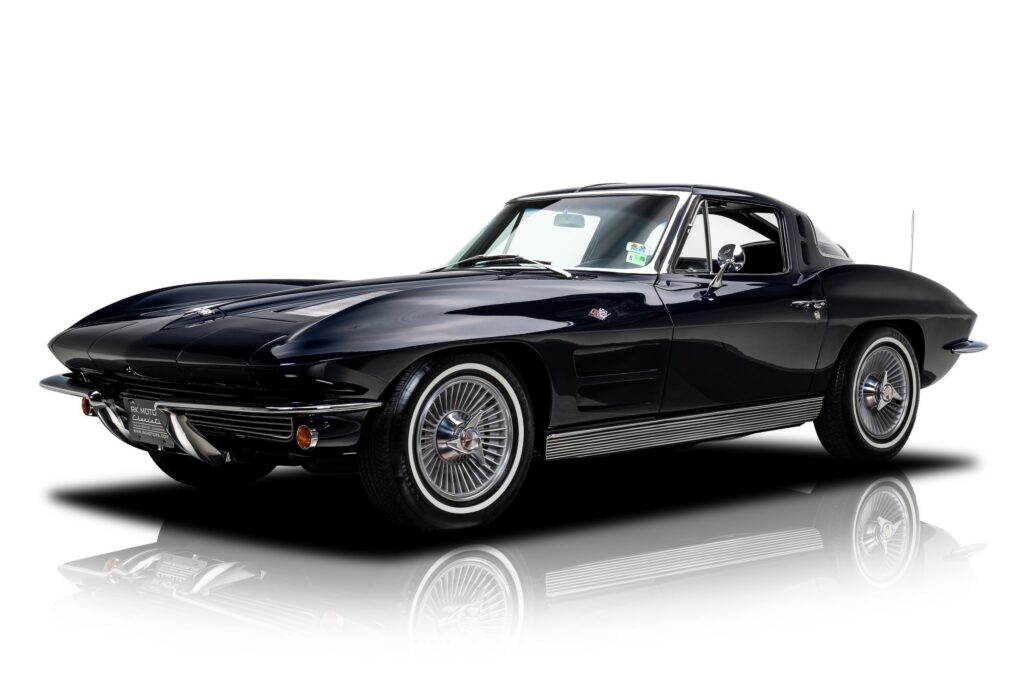
The divided rear window appeared on the 1963 coupe only, and that single-year design is why the split-window lives on its own rung regardless of engine. The market proves the point from the bottom up: a bare, frameless split-window shell brought $70,000 at auction earlier this year, as we covered here. Finished cars in recent 2026 sales have clustered roughly between $130,000 and $290,000, and Hagerty recently highlighted a $224,000 split-window as evidence of the C2’s staying power. A fuel-injected, documented split-window sits at the top of that range and above it.
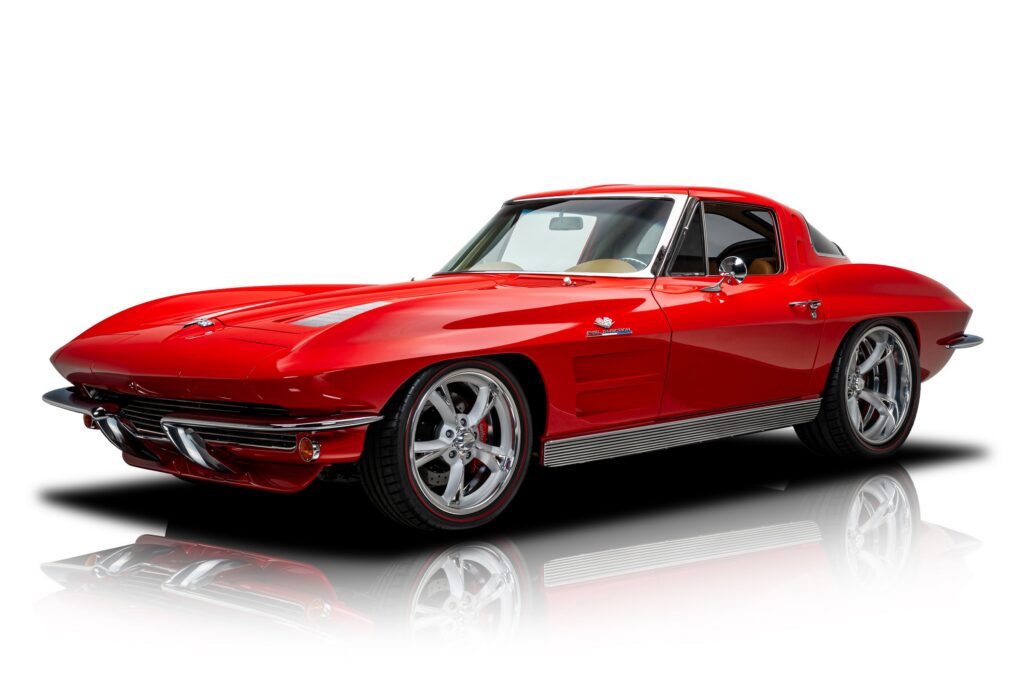
Split-windows are also where the factory-correct and restomod markets overlap most directly. RK Motors has sold both: a Triple Crown-winning, numbers-matching L76 split-window and an award-winning Art Morrison-chassis split-window restomod built by Lundquist Restorations.
Rung 6: Professionally built restomods
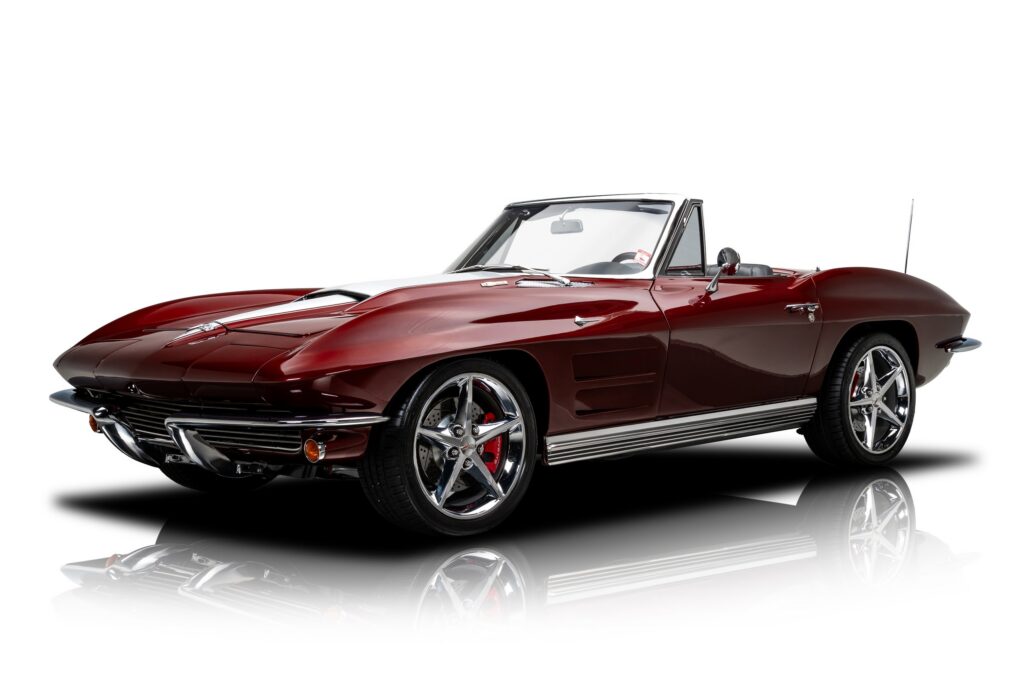
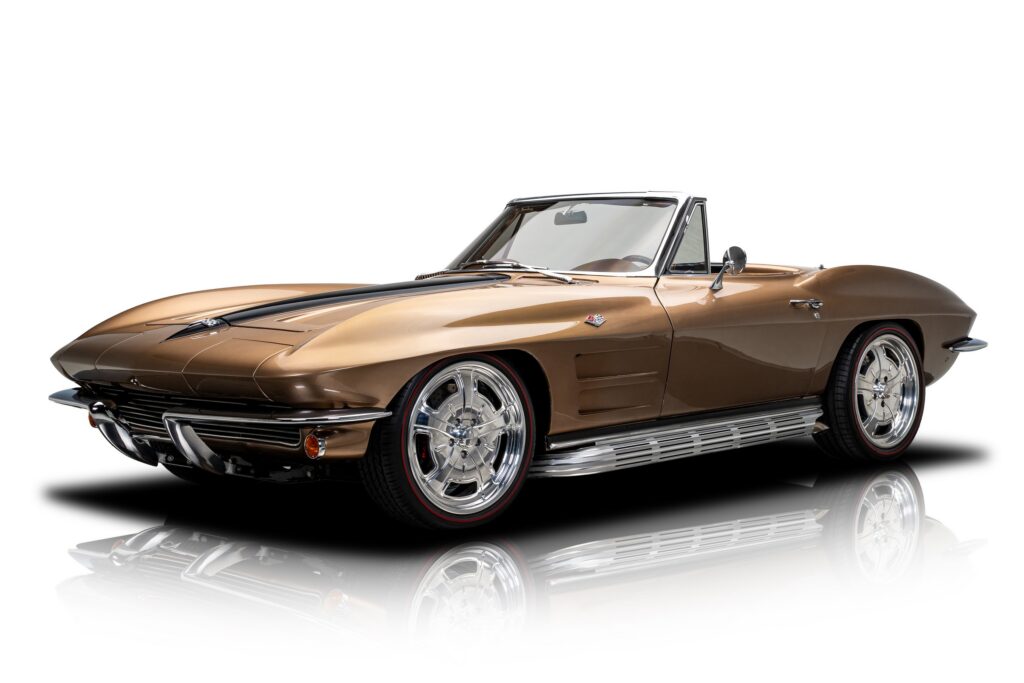
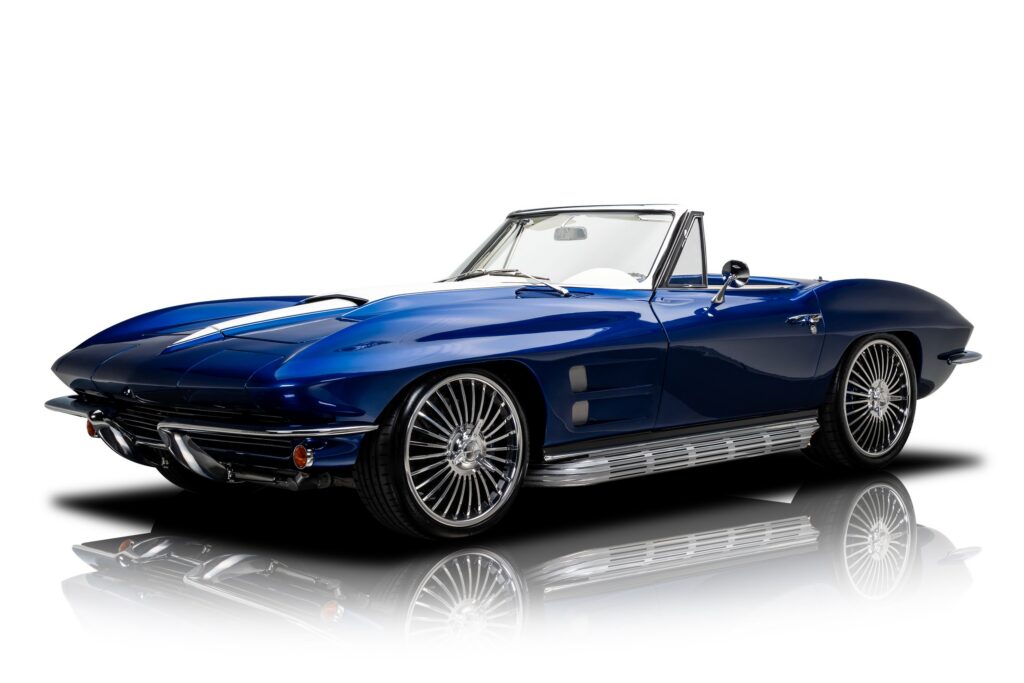
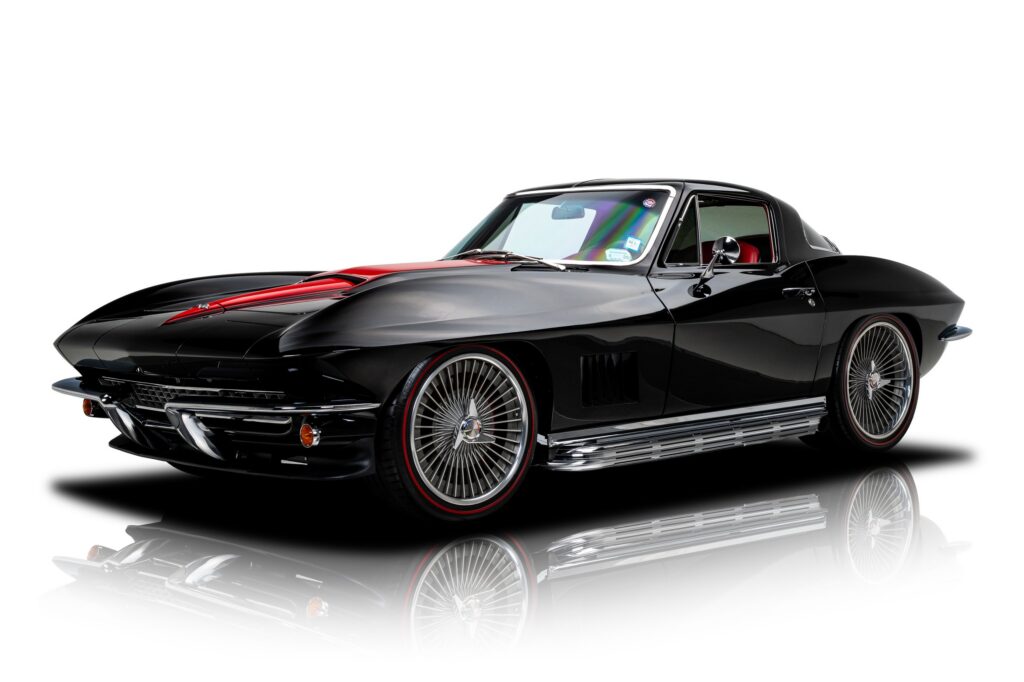
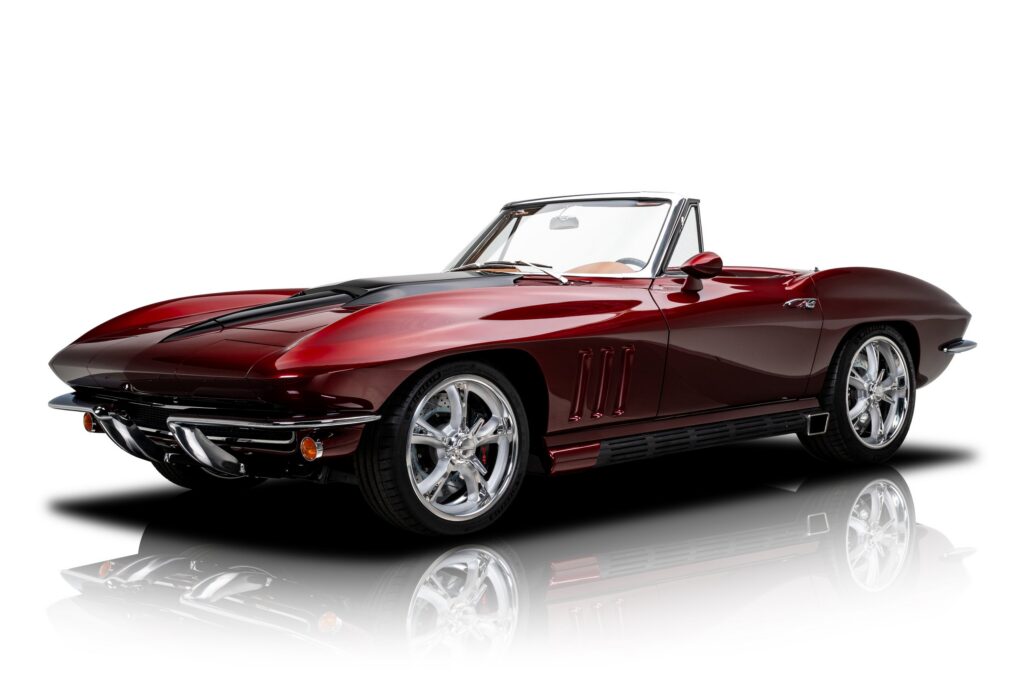
Restomod pricing is driven less by the original car’s engine code and more by who built it, what chassis it sits on, and how well it’s finished. As we explained in The Builder Signature Premium, a recognized chassis from Art Morrison, Roadster Shop, or Street Shop can add substantial value. Top-tier C2 restomods have sold for more than $400,000 at auction, including an Art Morrison split-window that brought $412,500 at Mecum Scottsdale in 2024.
RK Motors’ current C2 restomods illustrate the range:
- 1963 Corvette convertible restomod, 6.2L LS3, automatic, A/C: $195,900
- 1964 Corvette convertible, frame-off restored, 6.2L LS3, 6-speed: $199,900
- 1964 Corvette convertible restomod, 6.2L LS3, 6-speed, SRIII Stage 2 chassis: $269,900
- 1965 Corvette widebody by Vette Industries, LS3, Street Shop chassis, 5-speed: $369,900
Rung 7: Z06 and L88
At the very top sit the race-derived cars: the 1963 Z06 (199 built) and the 1967 L88 (20 built). These are auction-house cars whose values are measured in the high six and seven figures. CLASSIC.COM currently benchmarks the Z06 around $637,000 and the L88 around $1.39 million.
What Moves a C2 Up or Down the Ladder
- Engine code and provenance: the difference between an L79 and an L71 is roughly $80,000 at benchmark, and that gap only holds if the engine is real.
- Documentation: original window sticker, build sheet, Protect-O-Plate where applicable, and ownership history.
- Judging results: NCRS Top Flight and Bloomington Gold certification are independent verification, and combined awards (Triple Crown, Triple Diamond) mark the top of the factory-correct market.
- Body style: the 1963 split-window is its own market. In other years, both coupes and convertibles are strong; convertibles make up at least 95 of our 217 sold C2s.
- Options: Muncie four-speeds, Positraction, side exhaust, knock-off wheels, and factory air all matter on correct cars.
- Build quality (restomods): chassis brand, builder reputation, and fit and finish matter more than the original drivetrain.
Frequently Asked Questions
What is a C2 Corvette worth right now?
Most C2 Corvettes (1963–1967) are worth between about $85,000 and $200,000 in 2026, depending on engine, condition, and documentation. Small-block 300- and 350-horsepower cars benchmark in the mid-$80,000s to low-$90,000s; L71 427/435 and L84 fuel-injected cars benchmark roughly $168,000–$191,000. Split-windows and professionally built restomods frequently exceed $200,000, and the rare Z06 and L88 cars trade for hundreds of thousands to well over $1 million.
How much is a 1963 split-window Corvette worth?
Finished 1963 split-window coupes in recent 2026 sales have generally traded between about $130,000 and $290,000. Fuel-injected, documented, and judged examples sit at the top of that range. Even a bare, frameless shell recently brought $70,000.
What does “numbers-matching” mean on a C2 Corvette?
A numbers-matching C2 still has its factory-installed engine, confirmed by the VIN derivative stamped on the engine block pad matching the car’s VIN, along with a correct engine suffix code and casting and assembly dates that precede the car’s build date. Serious buyers also check the transmission, rear axle, and trim tag, and look for supporting paperwork such as a Protect-O-Plate or build sheet.
How much value does numbers-matching add?
There’s no single percentage, because the premium depends on what the engine is. On a base 327/300 car, a replacement engine is a modest deduction. On an L71, L84, L88, or split-window, the original engine is a large part of the value, and a car without it is often priced much closer to a lesser model. In RK Motors’ sold history, 23 factory-style C2s led their listing with “numbers-matching” and 44 cited NCRS or Bloomington Gold recognition, and those cars consistently sit at the top of the factory-correct market.
Does numbers-matching matter on a restomod?
Generally no. Restomod value comes from the builder, chassis, drivetrain, and finish quality. Many buyers do prefer a restomod built on a car with its original VIN, title, and birdcage, as with our Vette Industries widebody, which retains its original 1965 birdcage and title.
Is a big-block C2 worth more than a small-block?
Yes, typically. Hagerty data cited by industry analysts puts the premium around 57% for big-block cars in excellent condition. The exception is the fuel-injected L84 small-block, which currently benchmarks higher than every regular-production 427 except the L88.
How many C2 Corvettes has RK Motors sold?
RK Motors’ public sold inventory currently lists 217 Corvettes from the 1963–1967 model years, including 68 1967s, 50 1966s, and 31 split-window coupes.
Are C2 Corvettes a good investment?
We’re not able to offer investment advice. What we can share is observable demand: Hagerty reported North American C2 Corvette auction sales rose 15% in 2024 to $82.9 million, and C2s remain one of RK Motors’ most consistent sellers. Anyone buying with investment in mind should treat it as a discretionary purchase first and consult an independent financial advisor about their own situation.
Does RK Motors ship C2 Corvettes?
Yes. Every RK Motors listing can be shipped anywhere in the world, and each vehicle receives a comprehensive, multi-point inspection before it’s listed for sale.
Where can I see RK Motors’ current and sold C2 Corvettes?
Browse all current Corvette inventory, or review past sales in our sold archive, including the documented 1967 427 survivor and this Roadster Shop-chassis 1966 custom. For the bigger picture across generations, read The Corvette Ladder. If you own a C2 and are thinking about selling, learn about consigning with RK Motors.
Market benchmarks: CLASSIC.COM C2 Corvette market values by engine code and The Classic Valuer split-window sales data (September 2026); Hagerty market data as reported by Van Steel (April 2026); Hagerty Media. RK Motors data: public sold-inventory listings, September 2026.